Exhibit
1: Nine key segments in the manufacturing sector
Government
investments
The Indian government
is pursuing a comprehensive manufacturing strategy, deploying substantial
financial resources across key industrial sectors to strengthen domestic
production capabilities and reduce import dependence. This
strategic approach spans multiple industries, with significant investments
concentrated in two critical sectors.
The automobile sector
has received US$ 4.4B in funding in recent years, primarily through the
Production-Linked Incentives (PLI) scheme targeting 750K jobs and US$ 5.7B in
foreign investment, alongside electric vehicle promotion initiatives.
The electronics
manufacturing sector commands US$ 24.1B in government investment. The
Production Linked Incentive (PLI) scheme for electronics manufacturing in India
aims to boost domestic production and attract large investments in the sector.
Additional schemes, including the Electronics Component Manufacturing
initiative (US$ 2.7B), further reinforce this commitment.
Together, these
investments total over US$ 28B in government-led investments across the
automobile and electronics sectors - underscoring India’s commitment to
building globally competitive manufacturing hubs.
Exhibit
2: The Indian government has launched several schemes to support the
manufacturing industry
Key
training opportunities
Moving forward, within
these sectors, four training and learning opportunities stand out, based on existing
whitespace and propensity to deliver digitally. These include:
- Creating future
leaders from middle managers through business, leadership, and tech training enabling them to leverage AI
- Training on next-gen
skills and design tools like chip design, robotic programming, and CAD / CAM
software training
- Building
new-age manufacturing workers with tech readiness, soft skills, and safety
training
- Reskilling post-sales
service providers, especially for EVs and smart appliances
Exhibit
3: Key training opportunities in automotive and electronics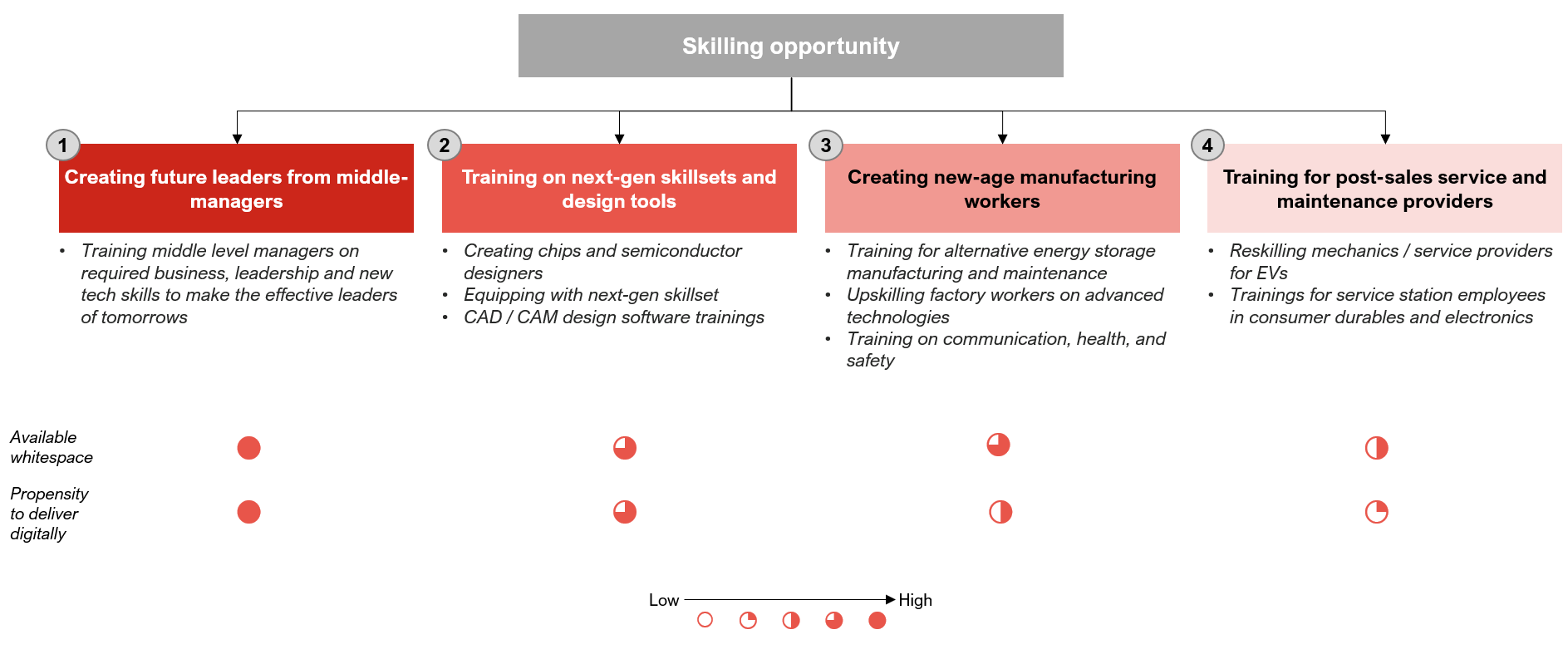 Opportunity for digital skilling platforms in manufacturing
Digital skilling
presents a significant untapped opportunity in manufacturing. While skilling is
critical to enhancing productivity, safety, and competitiveness in the sector,
there is a notable lack of scaled, digital-first platforms tailored to the unique
needs of the manufacturing workforce. Most existing solutions remain
fragmented, serve niche use cases, or are generalist enterprise learning
platforms that do not fully address manufacturing-specific requirements.
This creates a white
space for end-to-end, tech-enabled skilling platforms that integrate immersive
technologies like AR / VR for hands-on simulation, machine operation, and
safety training - essential components for upskilling both blue- and
grey-collar workers. A full-stack offering that spans content, certification,
assessments, and job placement can unlock large-scale adoption and bridge the
capability gap in this vital sector.
Conclusion
To truly realize
India’s manufacturing potential, bridging the skilling gap is essential,
especially with agile, digital-first solutions. As the sector transforms
through technological disruption, global supply chain shifts, and increasing
government support, the workforce must evolve in parallel. The growing demand
for EVs, semiconductors, and advanced electronics is redefining roles across
factory floors, engineering teams, and service networks. This calls for
continuous upskilling in both technical and soft skills, tailored to the unique
needs of each segment. The opportunity is clear - now is the time to invest in
scalable, future-ready skilling models that can empower India’s workforce and
unlock long-term growth.
How can Praxis help?
At
Praxis, we help clients decode evolving workforce trends and design
future-ready skilling strategies aligned with sectoral shifts. Our approach
combines deep sector insights with data-driven frameworks to identify critical
skill gaps, evaluate scalable delivery models, and craft targeted
interventions. We work closely with skilling institutions, corporates, and
ecosystem players to build high-impact, sustainable talent development
solutions across sectors such as manufacturing, healthcare, and BFSI.