Understanding
India’s vast workforce
India presents a
significant opportunity for skilling and vocational training, driven by its
vast and diverse workforce of approximately 420M (excluding agriculture).
Blue-collar workers make up the majority, accounting for nearly 292M
individuals — roughly 70% of the total workforce. White-collar professionals
comprise about 87M, or 20%. Additionally, there are 42M students across higher
education levels (post-K12), representing around 10% of the total, a future
talent pipeline that is set to enter the workforce in the coming years.
Employment in India
is driven by the sectors of manufacturing (98M workers across sub-sectors),
construction / infrastructure (68M workers), and travel & hospitality (39M
workers), together accounting for approximately half of the non-agriculture workforce.
Exhibit 1: Praxis Employment
Model shows a large skilling opportunity across the 292M blue collar and 87M
white collar workforce
Training is critical
for freshers and early-career professionals, especially in roles disrupted by
technology, where continuous learning is essential. In white-collar jobs,
upskilling is most needed in horizontal, sector-agnostic roles that face
frequent tech-driven changes. Senior leadership typically focuses on soft
skills and strategic updates, while other roles may only require periodic
refresher training and deeper sector-specific training.
In blue-collar sectors,
junior workers (0–4 years) in fast-evolving fields like healthcare and EVs face
a higher need for upskilling due to automation and process innovation.
Exhibit 2: 55–60% of the workforce have immediate
training needs to perform better in their current roles
Identifying
and analyzing prevalent business models India’s upskilling
and vocational training ecosystem operates under nine primary business models,
each catering to different learner segments with distinct approaches, as
illustrated in Exhibit 3.
Exhibit 3: Nine key
business models identified by mapping of players operating across different
learner segments
Learning from global trends
Beyond domestic
skilling models, global funding trends offer insights to understand
opportunities in the sector and how it is evolving.
Exhibit 4: Category-wise private funding raised by
vocational education companies
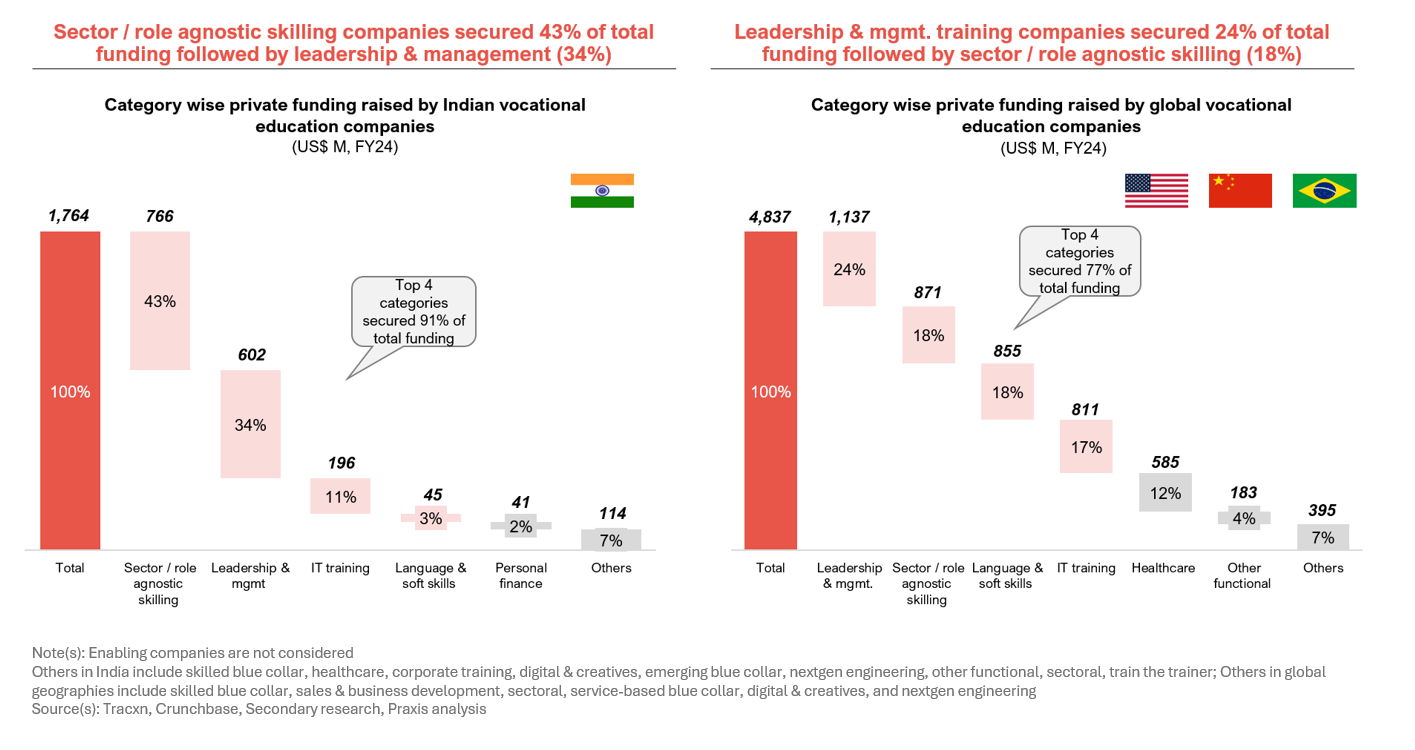
The top four categories viz. leadership
and management, IT training, language & soft skills and sector / role
agnostic skilling, are consistent both globally and in India. Notably, India's top four
categories capture a larger share of total funding (91%) than the global
average (77%), indicating a more concentrated investment strategy.
Globally, healthcare accounts for a significant
share of funding (12%) and is beginning to emerge as a key focus area in India
as well.
Conclusion
India’s vocational
skilling sector is evolving rapidly, fuelled by rising demand for skilled
professionals across industries. Training is expanding into technology-driven
areas like VR / AR in healthcare, robotics, sports, and upskilling of women to address gender inequality worldwide.This presents an opportunity for India to broaden its focus into specialized segments, creating a more comprehensive vocational landscape.
This creates a key
opportunity for targeted interventions. By pinpointing skill gaps and
leveraging innovative technology-driven business models, stakeholders can
improve the impact and reach of vocational training. Moving forward, investing
in diverse, outcome-focused solutions will be vital to empower India’s
workforce and prepare them for a rapidly changing job market.
How Praxis can help?
At Praxis, we help
companies identify workforce upskilling needs and evaluate the right models to
address them. As shown in Exhibits 2 and 3, our approach includes diagnosing
skill gaps across blue and white collar roles, mapping these gaps to emerging
skilling models, and assessing the scalability of targeted interventions. We
support clients - corporates, investors, and policymakers - in making informed
decisions on where to focus and how to build internal capabilities. Using
proprietary tools and frameworks, we bring clarity to a complex and
fast-evolving skilling landscape, enabling scalable, outcome-driven workforce
development.